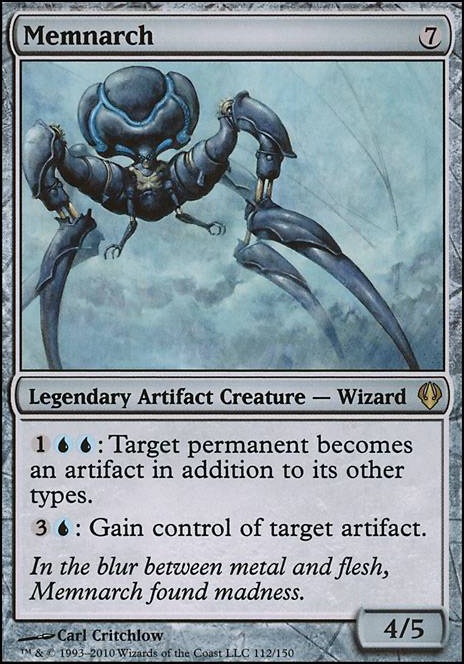
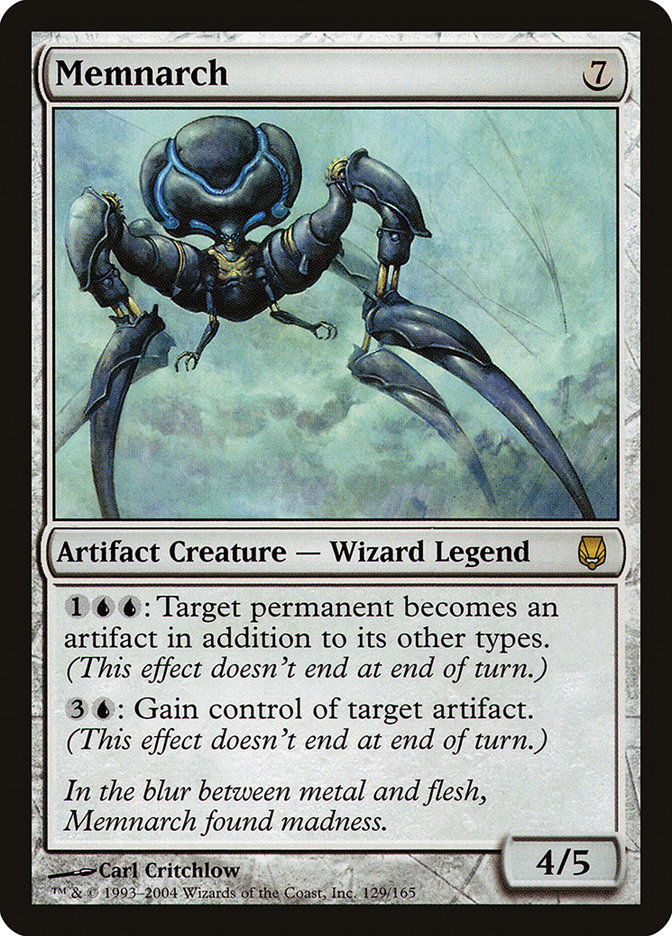
This is my pride and joy, the deck that best represents my passion for Magic the Gathering. Memnarch was the first foil legendary creature I drew, and remains my favorite character in the lore.
What’s easier than having an awesome mana sink that’s always available to you? Just make infinite mana and take all their stuff. Control, Card Draw, and Tutoring helps you get there, since you have to get your combo pieces and survive along the way. Counterspells are notoriously difficult to play in a game consisting of 3+ people, especially in a format as threat-rich as EDH. It is vitally important for me to keep my counterspells to either protect my own combo, or prevent other people from making a game-winning play. The sheer density of tutors that this deck possesses allows it to assemble combos with ease. The density of fast mana accelerates my gameplan, letting me do a lot of things early in the game.
This deck is a significant threat at all stages of the game, and most people who sit down with me realize how toxic Memnarch can be once they realize that he can permanently gain control of any permanent. I usually only cast Memnarch under two circumstances; when I have infinite mana, or when I need to put pressure on the board while I work on getting my combo together. Memnarch is a “Kill-on-sight” commander, and it is normal for people to hold up removal just to kill him when I play him. This deck is very rough to play when I’m not in the mood to get focused down, but it can be very rewarding when I unleash an easy two-card combo to make infinite mana and win the game. It is also fun when I set up a toxic board-state that allows me to steal multiple permanents each turn, such as having Unwinding Clock and Memnarch out with plenty of rocks. My opponents will usually scoop when they hear “On your upkeep, I’ll take two of your lands” multiple times. Fewer things bring me as much joy as taking my opponents’ lands!
This deck has quite a few number of game-winning combos. Here are the most relevant:
I seldom play this deck, mainly because my friends refer to this as a toxic deck. Many of my friends refused to get what they call “Memnarched”, as no one likes having their permanents (especially their lands) stolen. I do tend to win relatively easy against low-interaction, slow decks, which are the majority of commander decks out there it seems. It may seem powerful, but having minimal access to boardwipes and permanent removal makes this deck very vulnerable to aggro and go-wide strategies. Also, mono-green really has fun crapping all over this deck, as a well-timed Bane of Progress usually destroys my entire board. Despite all of that, I love playing this deck, even if it is a constant struggle just to stay alive during a game! 😀
This is the deck you pull out when you want to win in a shocking and unexpected way. This deck is a glass cannon, winning pretty consistently, pretty early, but only when playing it for the first time against unsuspecting prey. This deck can win subsequent games, but it will become increasingly difficult. What makes this deck this way? It wins with a single card: Ad Nauseam
Ad Nauseam is an instant that allows us to draw our entire deck, for the low cost of 5 mana and 35 life. Yes, the total CMC of our deck (minus Ad Nauseam) is around 35. Keeping our life total above 20 is important before casting Ad Nauseam, so that we can utilize our all-or-nothing package to win without dying to our own win condition.
In order to win, we first get Ad Nauseam by casting and exploiting Sidisi, Undead Vizier to herself. We will try and avoid casting any spells other than Sidisi if we can help it before we cast Ad Nauseam, unless we are ramping up to an early Sidisi/Ad Nauseam. We then cast Ad Nauseam on our turn, at sorcery speed. Draw as many cards as you can, as long as your life total is above 5. Ensure that you at least have Skirge Familiar, Dark Ritual, Lotus Petal, Mana Crypt, Exsanguinate, and 40+ cards in your hand. This is the easiest combo to win with, that doesn’t also kill you. Many first-time observers/opponents of this deck will be amazed at how you use Skirge Familiar to generate 40+ mana, or how you draw your deck (or most of it) while still being alive afterwards.
Other ways you can win include storming-off with zero-drops and one-drops, casting Tendrils of Agony to kill someone and gaining 40+ life, using Conjurer’s Bauble to put Tendrils back into your empty library, draw it, then cast it again to kill someone else, then cast Sickening Dreams to kill off the last remaining players while still surviving with your padded life total. Or, you could just draw your deck, play Glacial Chasm, then cast Sickening Dreams, discarding 60+ cards to deal 60+ damage to each creature and player other than yourself. There are…multiple options once you draw your deck. 😀
This is a deck I wanted to build for years, and finally did so thanks to my recommitment to completing The Great EDH Challenge. This deck is very fun to play, especially when you get a turn 3 Ad Nauseam using Lake of the Dead shenanigans combined with fast mana. It’s always funny to see people’s response to this weird deck, ranging from salt to genuine amazement. This deck really highlights how crazy powerful EDH can be, or perhaps just how busted Ad Nauseam is when you have a tutor for it in the command zone.
This is a fun deck. Being able to plop out Rograkh turn one, quickly start voltroning him up, and then making him deal triple damage with Jeska is a real joy. If you can manage to sacrifice Jeska with Claws of Gix after using her 0 on a 3+ Power Rograkh, cast her again, then use her 0 on Rograkh again, he will do NINE TIMES damage and swing for lethal! Haven’t managed to do that yet, but I was able to deal 15 in one swing by tripling his damage with Jeska. I’ve only played a handful of games with the deck, but it has already proven to be deceptively powerful.
Jeska is very versatile, with her ability to deal X damage to 3 targets. Most of the time, this will be used to kill 3 problem creatures. Recasting her throughout the game allows her damage to scale very well as the game progresses. She clears the way for Rograkh to deal combat damage, acting as a targeted board wipe later in the game. In the games I have played with this deck, my opponents get very frustrated when they realize how hard it is to have their creatures stick when I can easily destroy them with Jeska. It is this fact that makes me think of her as “busted,” and a return to the thing that makes Red great; dealing damage.
Of course, many have realized that she is a mana sink in the command zone, allowing you to deal infinite damage by making infinite mana. That’s why we run a few infinite mana combos, for when attacking with Rograkh just doesn’t cut it!
This is your typical mono-white lifegain deck, with an infinite combo thrown in for good measure. It also has another piece of secret tech; Divine Intervention. Making the game a draw usually causes even more frustration amongst my opponents than if I won, ironically enough. In any case, this deck gains some life and hopefully draws into a win condition with Mangara’s insane passive draw abilities. When I saw Mangara, a character I love from the lore, given a new card that draws a ton in mono-white, I knew I had to make a deck with him at the helm. The deck performs pretty well, and has quite a few ways to win.
Combat is an adequate win condition, and the way I win most of the time with this deck. Playing a bunch of angels, a subtheme of the deck, with evasion can really put the pressure on opponents. Especially when they are buffed by True Conviction, Ajani Steadfast, and/or Lyra Dawnbringer herself. Swinging with Angel of Destiny is likely to just cause an opponent to lose on my end step, considering how much lifegain is in the deck. Passive token generators like Griffin Aerie, Court of Grace, and Angelic Accord expand my team to put more pressure on my opponents.
Alternate win conditions abound in this deck. I’d forgotten how many of these existed for lifegain strategies. Felidar Sovereign, Angel of Destiny, Test of Endurance, and possibly Aetherflux Reservoir can all win with enough life and a little bit of time. It is always funny to see my opponents frantically look at their hands and ask each other if they can remove these threats from play to stave off my eventual automatic win, especially if I have over 100 life. Ah, it feels good to win without relying on _uncivilized _ combat, if I can help it.
There is one deviously simple infinite combo in the deck, that of Heliod, Sun-Crowned and Walking Ballista. Yes, the combo that got the poor artifact banned from Pioneer. For the total cost of 7WW and two cards, you can deal infinite damage and gain infinite life. Hmm, I guess it is a bit more expensive than I thought, but you don’t have to pay it all at one time!
So that’s the deck folks. Various lines of play that can lead you to victory, with plenty of interaction to keep the game interesting. I will probably be optimizing the deck a bit in the future, once I start playing with it more often. As it stands, it is pretty casual, and I kind of like it that way.
This is my casual mono-green spirits deck. It has been the butt of many jokes by my playgroup, who think that this deck is incredibly weak. Despite their views, this deck has a pretty good win rate. When people see my commander, and the weird spirits that they’ve never even heard of, it takes pressure off of me during the game. I have been able to amass a ton of spirits, lord them up, and swing for lethal several times. This deck may not be fast, or flashy, but it is always interesting to play in a more casual pod.
Sekki can make a lot of spirit tokens, especially when he has been given an additional toughness. His damage prevention / token creation replacement effect makes for very interesting combat, when I am able to get him out. By the time the uninitiated realize that he has this ability, I have probably created dozens of spirit tokens. Heck, even my regular playgroup makes this mistake time and time again.
The rest of the creatures in the deck are primarily incremental value engines and minor threats, to put pressure on my opponents until I play Sekki. There is a good amount of removal in this deck as well, as much casual interaction that I could manage in green while keeping the budget within acceptable limits. I would run Wave of Vitriol merely to watch the wave of vitriol it usually causes when you make a 4 or 5 color deck sac all their lands without replacements to search for, but I run too many utility artifacts and enchantments for that.
I look forward to changing out Sekki for Kamahl, Heart of Krosa and Kodama of the East Tree when I get ahold of them soon. Should make for an interesting boost in power! Interestingly enough, a friend of mine who always speaks ill of this deck told me that changing out the commander would be disrespectful to Sekki. Despite me rolling my eyes at his duplicity, I did feel a pang of guilt about getting rid of Sekki as the commander. But alas, change is the spice of life!
This deck has a simple gameplan; Ramp up to cast Ulamog. Ulamog is quite powerful, being able to exile 2 permanents when you cast him, as well as kill in three hits on average. And if he wasn’t bad enough, making an opponent exile 20 cards from their deck is brutal and demoralizing. There are a few other pay offs to the ramp, such as It That Betrays and Walking Ballista, and there is a small equipment package to make your smaller creatures into threats in case you stall out before reaching 10 mana.
There have been plenty of times when I have put Assault Suit on Ulamog, and passed him around the table. Opponents are oftentimes giddy to swing him at their declared enemy, and sometimes even gang up on one problem player to eliminate them completely. I have put Worldslayer on Ulamog a few times, and watched as my opponents look helplessly as I destroy all permanents other than Ulamog and his sword. Fond memories!
My friends constantly keep an eye on me when I play this deck, constantly asking “How much mana do you have?” each turn. They know that when I get to 10 mana, I’m going to exile two problematic permanents. There is a lot of pressure put on me when I play this deck, even though it is inherently weaker than others at the table, but I understand the dread of having your board state disrupted in an almost uncounterable way.
Many games have been spent having my artifacts picked off to prevent me from reaching 10 mana before turn 10, which is annoying. But most of the time, I can recover quickly and get Ulamog down. Him being indestructible really helps him stay on the table. Despite knowing that, it is always a surprise for me when he sticks around for more than one turn.
If all else fails, just voltron up a Plague Myr and kill them with infect!
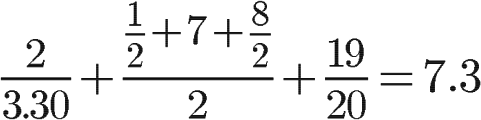
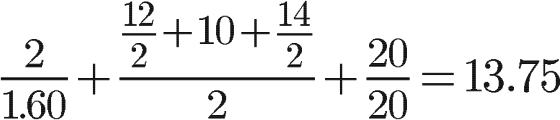
To aid in better grading the power level of EDH decks using a 1 through 10 grading scale, I have created a handy formula that can be utilized with any deck.
or in Latex:
Let’s break down what these variables mean.
A = Average CMC of the deck.
This one is rather straight-forward. The higher the Average CMC of a deck, the slower and clunkier it becomes. By having 2 divide by this value, I am increasing the number of points awarded to decks with lower CMCs, while reducing the points awarded to decks with higher CMCs. A always has a minimum value of 1, to avoid someone getting a high power level for having 90+ lands in their deck.
D = Draw that either allows you to see 3 cards, or a permanent that gives you repeatable draw Examples: Brainstorm, Howling Mine, Fact or Fiction, Phyrexian Arena
Draw is an important way to ensure that you are always able to perform actions during the course of the game. A deck with little to no draw will spend most of the time sitting around doing nothing. The value of the draw spells are just as important as their density, which is why I have restricted this value to draw that gives you more card selection, or generates value over a longer period of time. These factors ensure that you always have things to do on your turns. In graveyard decks, it may be necessary to count self-mill cards that share the same stipulations (lets you see 3 cards, and/or is a permanent with repeatable draw) as draw for this variable.
T = Tutors (with CMC 4 or less) that find combo pieces and other win conditions Examples: Vampiric Tutor, Muddle the Mixture, Tribute Mage, Demonic Tutor
Tutors get you exactly what you want, usually when you want them. They give EDH decks a level of consistency that more casual players would say is not in the spirit of the format. Their main function in higher power levels are to attain game-winning combo pieces. The cheaper the tutor, the more likely it is that the player will be able to use the card they tutored for during the same turn. Because of this, this variable has the greatest weight of any of the other variables in grading power level.
R = Ramp cards with CMC 2 or less Examples: Llanowar Elves, Rampant Growth, Plague Myr. Sol Ring
Ramp is a major determinant of how fast a deck will win consistently, alongside cheap tutors. The sooner a player has access to a large amount of mana, the sooner they can cast multiple spells in a turn. A game of magic is usually over when a player can cast multiple spells in a turn before their opponents can. This, of course, is more impactful in the first few turns of the game, which is why only inexpensive ramp makes the cut for this variable.
I= Interaction such as counterspells, targeted removal, board wipes, and even stax Examples: Mana Drain, Swords to Plowshares, Damnation, Winter Orb
Interaction stops your opponents from winning the game before you do. It is vitally important, but only when there is a high density of it. Having two or three forms of interaction won’t do much to consistently answer threats during a game with 3 opponents. This reasoning is why I have this value divided by 20, to reward a high density of answers.
Stax is a very broad-ranging term that means many things to many people. In this case, I define it as cards that slow the game down significantly as their primary purpose, limit what actions players can ordinarily take, and tax opponents to build value for yourself. This includes Mass Land Destruction (MLD), Hatebears like Drannith Magistrate and Grand Abolisher, and even Pillow Fort like Propaganda.
There are a few things that I would like to note, based on community advice.
Commanders count as 2 toward their respective variable, even if they are costed higher than the respective variable’s limitation.
For example, Tymna would count as 2 towards D (Draw), and Sidisi, Undead Vizier would count as 2 toward tutor, since she is always available. This is a workaround to the fact that this formula doesn’t handle commander-centric archetypes well, such as decks like Sram and aggro Tribal decks like Krenko.
Graveyard strategies may require creative consideration for variables.
A card like Mesmeric Orb may not count as draw in most decks, but it could be very powerful draw in a Muldrotha deck. Entomb may not seem like a tutor in most decks, but it can be a very powerful tutor in a Karador deck.
Because of the difficulty of quantifying “Average Win Turn”, this formula focuses on how fast a deck can potentially amass a winning boardstate instead.
Having R (Ramp) be limited to spells CMC 2 or less is an easy way to denote that early game acceleration is what it is representing. The same is true to a certain extent with regards to T (Tutors). These values are weighted heavily for this very reason.
With the commander out, the score can actually change.
However, this formula leans heavily on representing the flow of gameplay, focusing on the early game. If you can get your commander out with early ramp, that will be reflected in the formula, actually. It may be interesting to have people compare two results of the formula; for when the commander is not in play, and when the commander is in play. Many cards will suddenly belong to variables that they did not otherwise belong to.
This formula is a generalist tool, not meant to score unique commander-focused decks.
These variables work because they are metrics that can be widely agreed upon to be signifiers of power, speed, and consistency. Synergy in EDH is a very esoteric value, that varies greatly between decks. Because of that, I choose to focus my efforts on providing a tool for most decks, not all. All decks can benefit from Ramp, Draw, Interaction, Lower Average CMC and even Tutors.
Lands are largely a no-brainer, contributing little to power level in a well-constructed deck.
Playing minimal tap lands will make most decks better able to play during the early game. I make the assumption that the decks playing tap lands will be scored lowly by the variables of this formula. because those sorts of decks seldom run low cmc ramp, tutors, and draw.
From my own calculations utilizing this formula, I have been able to create a nice baseline of power levels that are usually below 10 and above 3. I have found that meta-“cEDH” decks seem to consistenly grade above 10, though this formula is not meant to accurately grade meta-specific decks such as cEDH decks. I will go through 5 examples of varying deck types. These formulas may not include changes to the variable calculations that have been implemented using community feedback.
As you can see, this scoring method is a good metric to gauge a deck’s general power level when factoring in deck traits that define the EDH meta. A deck with a score over 10 is most likely a competitive deck, perhaps belonging to the “cEDH” format. I like that it appears to turn out that way, as it puts those deck in a “tier of their own”, as many remark cEDH decks as being already.
Moving forward, I will be grading any EDH decks I discuss on this site using this formula. I look forward to hearing your thoughts on this grading formula, and seeing your own deck power levels as defined by this formula.
I decided to reattempt the Great EDH Challenge. This challenge entails making an EDH deck of each color combination, 32 decks in total. I aggressively pursued this challenge several years ago, but was never satisfied with the unofficial 4-color options of the time; the Nephilim. But with the C16 Commanders, and their accompanying Partners, I can rightfully complete the challenge.
I will be spending several posts going through the decks I have chosen to create to complete the challenge. This is the ultimate challenge in deck creativity and expression for me, so I look forward to going through my decklists. Deck construction is perhaps my favorite thing about MtG, perhaps even more than playing the game! In any case, this is the list of decks, to be updated upon their completion:
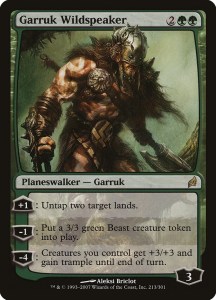
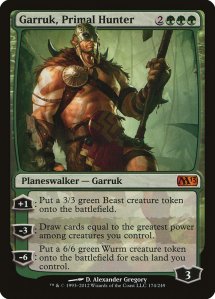
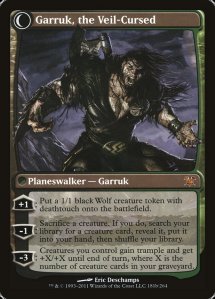
When I returned to the game during Shards of Alara, I was introduced to the new card type; Planeswalker. Initially, I hated the idea of planeswalker cards, since their design allowed them to act as a second player on the side of their controller, and there weren’t many ways to get rid of them if you weren’t playing creatures. But when I saw and subsequently played with Garruk Wildspeaker, I fell in love.
I didn’t fall for the planeswalker card type, but I did fall in love with the huge, manly, savage guy who happened to be a planeswalker.
I’ve always had a great affection for the beefcake and barbarian archetypes. I remember reading old issues of Conan when I was a little kid, and marveling at his wild might and musculature. This was mimicked in many other works I viewed at that age, like The Incredible Hulk, Dragonball Z, and Hokuto no Ken. Perhaps it was because I’d been the scrawny kid who everyone saw as weak, and I was looking up to these powerful men who could defeat any enemy with utter brutality. That affection evolved into a general attraction as I entered puberty, so I began to seek those sorts of characters out more and more. It is an ideal that I never had any desire to embody myself, but to instead admire it in others who possess it.
When I began exploring Garruk’s lore, I began to be captivated by his “hunter druid” nature. I’d been reading the MtG novels for years already, so I was very captivated by Magic’s worldbuilding and flavor. But with Garruk, I had digital comic books to read, which really got me excited. The story of Garruk’s fight with Liliana, “The Hunter and the Veil,” left a pretty bad taste in my mouth, but I had hope that Wizards would do something interesting with him soon. It took a year, but they did continue his story with “The Veil’s Curse,” which had a cool fight between Jace and Garruk, with Garruk breaking through the blue mage’s spells with ease. It was shortly followed by “The Wild Son,” which gave me a greatly appreciated insight into Garruk’s simple origins. This was the first story I really liked, and emboldened my interest in his character.
After reading the comics featuring Garruk, and learning of his humble beginnings, I began to really dislike the direction they’d taken his character. Being cursed by the evil wench Liliana, Garruk was corrupted and made ugly and vile. I really grew to hate Liliana as a character, and hoped that Wizards would find a way to cure and redeem Garruk. My greatest hope for this was a novel that was to be released back in 2010, called “The Curse of the Chain Veil”. However, it was never released, and I wouldn’t get anything lorewise concerning Garruk until 2012. Although, I did get several cool and interesting new Garruk cards while I waited, so my appetite was sated for a bit.
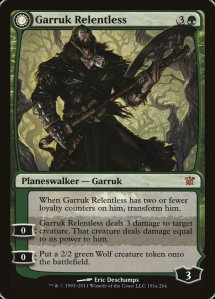
After Garruk’s story in Innistrad, where he was almost healed by Avacyn, his story became more and more dark, as he began to accept the curse, and the fate it brought him. I lamented this, especially with the culmination of this corruption storyline in M15, the Garruk-themed set. A part of me celebrated Garruk being center stage, but a larger part wished for the neutral-aligned mono-green hunter druid that I’d fallen for years ago. I’d felt that Wizards had run out of ideas for Garruk, and that they weren’t going to cleanse him of the curse that had turned him into a murderous, evil planeswalker hunter. But I have to admit, the card this version of Garruk received was pretty cool, and fun to play with.
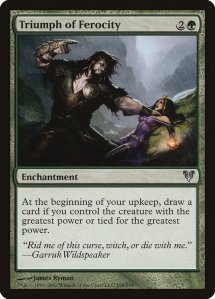
As Wizards increased its efforts to gain new players in the coming years, I noticed that Garruk became nearly non-existent within the game. He’d seemed to have been completely replaced by the Elf planeswalker, Nissa Revane, who I saw as boring and unoriginal. The idea of a main character “hunter druid” had been somewhat fresh, but an elitist elf who was in touch with nature was a bromidic trope. I began to wonder why he’d been given a character-centric set, only to be abandoned at the climax of his corruption arc. I began to talk to others about this, and they told me to look at a card found in Innistrad called “Triumph of Ferocity”. I’d been out of the game during the Innistrad block, only peeking my head in to do a few drafts, so I wasn’t familiar with the cards, or the controversies, until I returned for the RtR block.
The Magic fanbase has been composed of a large number of immature, socially-inept guys as far back as I can remember (myself included, once upon a time), mainly consisting of young white males whose humor was oftentimes crass and disparaging. I’d oftentimes find myself at the butt of racist jokes, being the only black guy in some of the card shops I’d frequent. It didn’t bother me, because I knew that the guys were just being silly, and didn’t have hateful intentions. Nothing was off-bounds, whether it be sexist, homophobic, or racist. It was the sort of environment where you gained a tough-skin pretty quickly, because everyone else would point fun at your hurt feelings if you were offended by anything that was said. It was challenging, but also fun. It was an environment where you knew you could say pretty much anything you wanted. But that environment also incentivized saying the worst things you could think of, because it was a sure way to get a laugh.
That’s why I could understand how most of the guys I knew got a real kick out of the art displayed on Triumph of Ferocity. When I brought up the card to some MtG friends of mine, they always joked about it. Most of the jokes were sexual, saying things like, “Liliana and Garruk are so into each other, they even get into BDSM”.
It wasn’t much of a problem for magic players back then, but things quickly began to change as new, more diverse players began to flood into the game. Wizards was on a mission to make the game inclusive, and that meant removing things that would be “problematic” to new players who didn’t share the crass humor of many of the older players. A wave of inclusivity began to sweep through all sorts of industries and fandoms during 2015, as movements like Gamergate began to show a darker side of nerd culture to society at large. Wizards, being a center of nerd culture, made it a priority to clean up the public’s image of its nerdy player-base. “Triumph of Ferocity” began to be looked at by new players, and some of them began speaking about the sexism present in MtG. It is around this time that Garruk ceased to be present in the game. The writers of Wizards would add a little blurb about what he was up to every now and then, but that was it. I felt as though M15 had acted as a grand send-off to a character that Wizards realized needed to “disappear” for the good of the game’s inclusive future.
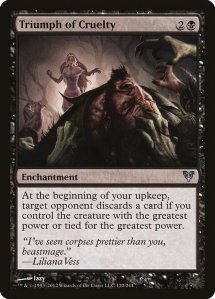
To me, it is tragic that Wizards would get rid of a character simply because of a single unflattering card art he was in years ago. It isn’t as though he was harming an innocent woman. Liliana and Garruk were engaged in a fight, where she had the upper hand. She refused to remove a curse that was partly responsible for Garruk’s aggression towards her. Liliana is an evil necromancer, obsessed with power and enamored with cruelty. She also got her turn to hurt Garruk during the fight, as depicted in “Triumph of Ferocity’s” opposing card, “Triumph of Cruelty”.
As The War of the Spark draws near, Magic’s first Planeswalker-themed set, I couldn’t help but reminisce about Garruk’s fate. 36 planeswalkers that will appear within the set have been revealed, with indications that they will be the only planeswalkers that will receive new cards within the set. Garruk was not among them, and hasn’t even been mentioned yet. Is this a confirmation that Wizards has indeed written him out of their larger narrative, relegating him to a few sentences in a “Catching Up” story now and then? I certainly hope not. And if there’s anything that Garruk has always given me, it’s hope that his character will get the compelling story he deserves.
EDH/Commander is my favorite format. It allows such a wide range of deck-building options, and you can really express yourself through your decks. This appeals to me greatly, especially when I see theme decks, and especially flavorful decks. I tend to make either really powerful decks, or really casual decks.
I’d like to share my favorite commanders with all of you, within 4 different posts. This time, I will cover my favorite mono-color commanders. Mono-color commanders offer the purest color pie experience in EDH. The decks are oftentimes single-minded, having access to only one color. You really get to see the weaknesses and strengths of each color, even with access to nearly all of the cards in magic’s history.
Mono-Blue : Memnarch
Memnarch is probably my favorite creature in MtG. He is the World Warden, the Wicked Wizard, the Obsessive Overlord. Memnarch takes your permanents…all of them.
With infinite mana, Memnarch serves as the best theft-based mana sink in the game. He keeps your opponents’ permanents….permanently. He turns card advantage on it’s head, by allowing you to gain an advantage while disadvantaging your opponents. Normally, filling your deck with mana producers seems underwhelming, but Memnarch turns any excess mana into additional permanents on your battlefield. He is oppressive, yes, which is why I only play him when I’m playing against other powerful combo decks. And with a head that big, how couldn’t he out-think his opponents?
Strength : Card Advantage
Weakness : Aggro Decks
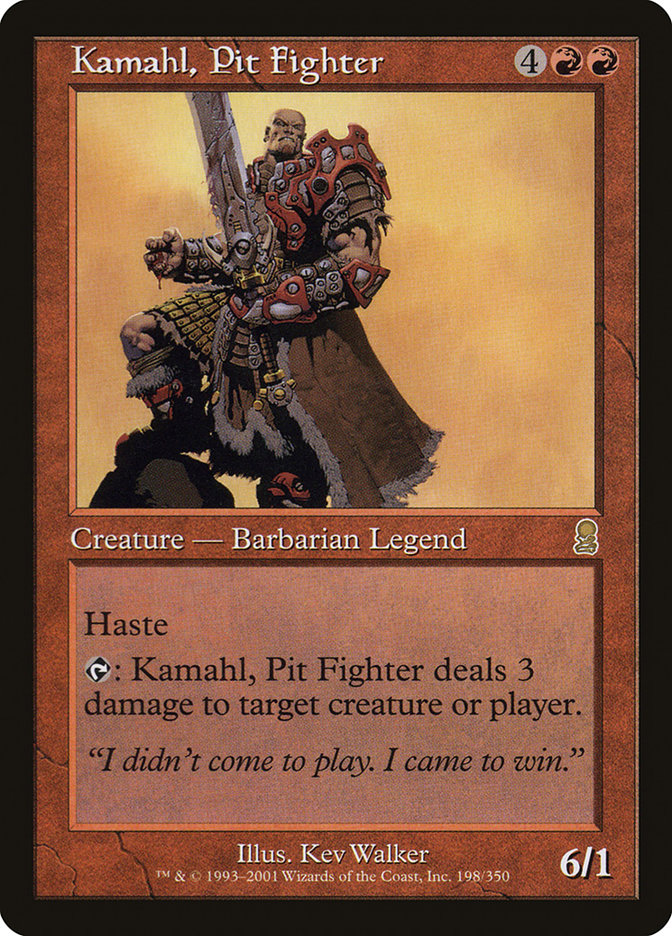
Mono-Red : Kamahl, Pit Fighter
Kamahl is the champion of the Pit. He is a vicious gladiator, coating his massive blade with the blood of his opponents. Pretty manly, eh? Alas, he lacks stamina; he is a one-minute man. But man, does’ he know how to smash during that minute!
Kamahl is the king of pingers. He is a lightning bolt on a stick, who deals 3 damage to any target the moment he comes out of the command zone. But more importantly, he comes out swinging, possibly doing 6 commander damage to an unfortunate opponent. He is aggressive, and also shoots lightning bolts. To me, Kamahl is a red purist, epitomizing the classical aspects of the color. You can build him as tribal pingers, or you can voltron him up, or you could just run burn spells and hasty creatures. His versatility is his strength, just as it was in the Pit.
Strength : Damage
Weakness : Big Booty Blockers
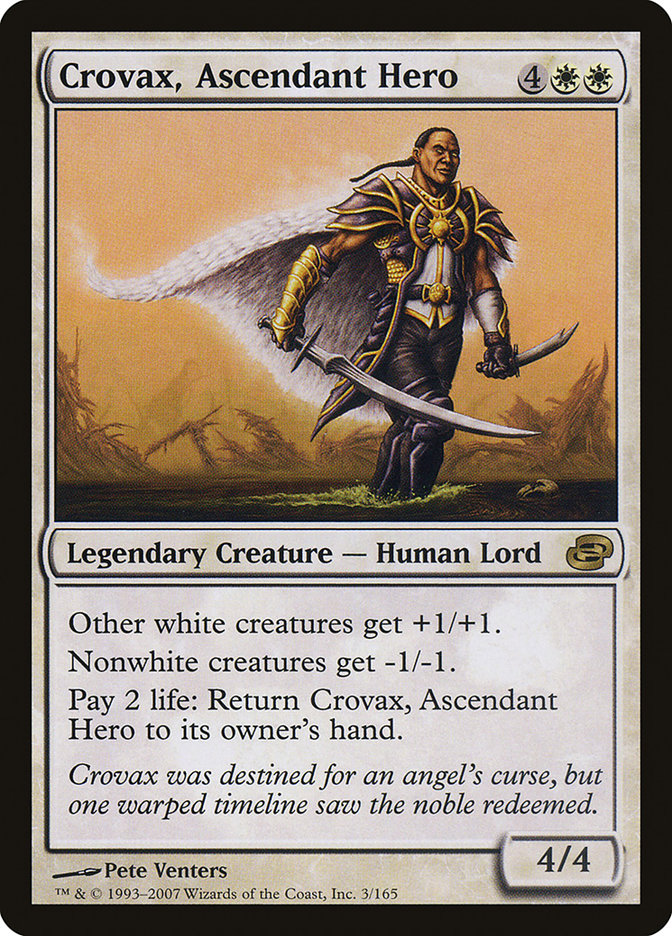
Mono-White : Crovax, Ascendant Hero
The Time Spiral Block gave us so many amazing remixes of the color pie, game mechanics, and even previous characters. Crovax is known as being a merciless vampire, corrupted by Phyrexia and turned against his previous allies. His story is complex and nuanced, creating a multi-faceted character with a living, breathing history. In typical What-If fashion, Planar Chaos gave us a parallel universe-version of Crovax, who’d been cleansed of his corruption, and who became an incredible force for good.
I love Crovax, and always wished he’d gotten a happier ending during the Weatherlight Saga. This card gave him that happier ending. Because he fights against the evil that had corrupted him, and as such, I build him with a Black-Hate theme. Because he fights the darkness, I have him joined by a team of creatures that have Protection from Black, and various tools to lock down their black minions and the swamps they come from. Crovax is an anthem that can be saved from nearly everything for 2 life, who sometimes nerfs your opponents’ creatures. He is the hero we deserve, but not the one we need when we’re not going against a black deck. 😀
Strength: Going against Mono-Black decks
Weakness : Going against another Mono-White deck
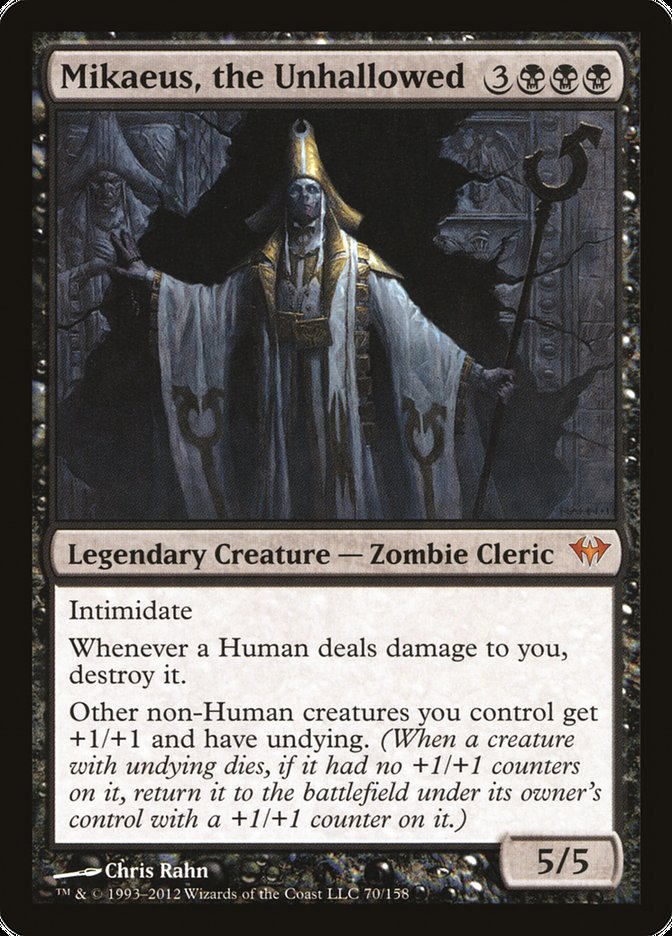
Mono-Black : Mikaeus, the Unhallowed
Poor Mikaeus. Once a religious leader, he was turned into a zombie by that evil wench, Liliana. Just as she corrupted my favorite Planeswalker, Liliana defiled the pious Mikaeus, and used him as a puppet for her own ends. A tragic end to a holy man who tried his hardest to preserve a dying faith.
This Zombie is actually a combo machine. He goes infinite with so many cards that it borders on ridiculous. And with access to Black, you can easily tutor for all of your combo pieces. Bring pack your creatures endlessly, while draining or pinging your opponents to death death in the process. It’s easy as 1. 2. 3 combo pieces! I solemnly swear as a Johnny player that Mikaeus is a combo player’s wet dream. Humorously enough, I almost always forget that he destroys humans that deal damage to you!
Strength: Winning Outright
Weakness: Getting Hated Off the Table
Mono-Green : Kamahl, Fist of Krosa
Look who decided to become a member of the Green Party! Kamahl had a revelation within the deepest parts of the Forest of Krosa, and spent a great deal of time meditating on all of his past crimes as a Mono-Red brute. Being taught by the forest and it’s protectors, Kamahl became a druid, and found an inner peace through continued meditation. His future was not a peaceful one, however, seeing how he was forced to kill his own sister, who’d essentially been turned into an avatar of death by the evil Cabal.
Kamahl’s Green incarnation is even more versatile than his red one. Not only does he turn lands into prime targets for removal, but he also pumps your entire team. Overrunning your opponents with infinitely big creatures is always good for a laugh, and a win! Just as he epitomized the classic features of Red in his previous card, the Kamahl represents what makes Green great; the ability to punch your opponents really hard. I mean, look at those bulging muscles!
Strength: Big Brawny Creatures
Weakness: Board Wipes
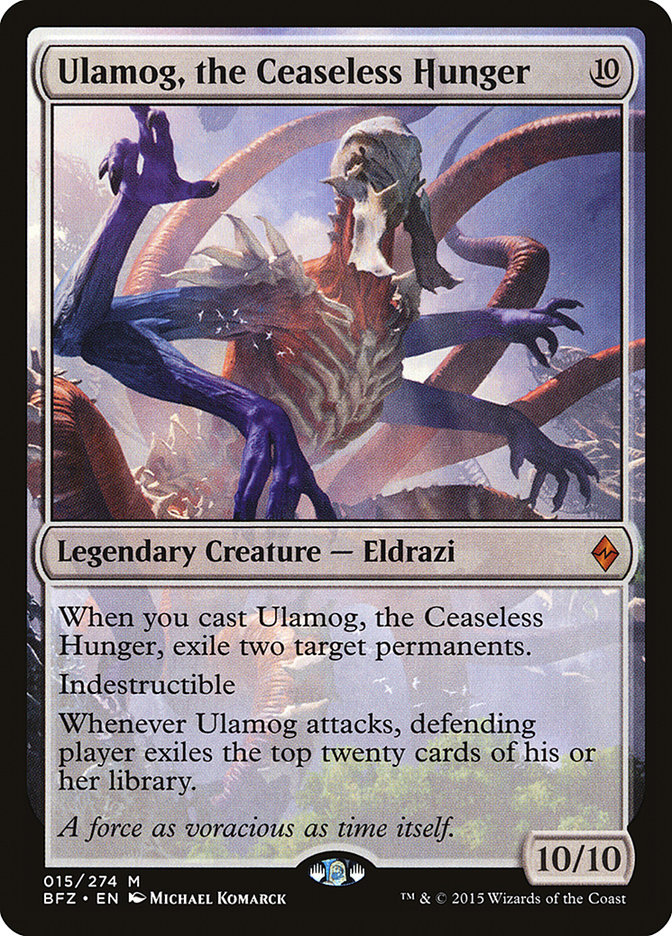
*Colorless – Ulamog, the Ceaseless Hunger
To finish things off, let’s cover the mysterious and inherently weak Colorless….color? Not having access to colored mana drastically reduces your options for things like early interaction, but it doesn’t matter when you fill your deck with artifact ramp and slam down the always cranky, never lackluster Ulamog.
Eldrazi Titans are notorious for their cast triggers, which normally ensure that you aren’t wasting large amounts of mana to cast a spell that might just end up getting countered. Spending 10 mana to exile two permanents is pretty amazing by itself, but imagine getting a 10/10 indestructible creature out of that has a disgusting attack trigger! And by the way, you always have access to it! EDH is one helluva format, eh?
Strength: Exiling Stuff
Weakness: Slow to Interact
Tune in next time for my favorite 2-color commanders!









 Disciple of the Vault

