When I returned to the game during Shards of Alara, I was introduced to the new card type; Planeswalker. Initially, I hated the idea of planeswalker cards, since their design allowed them to act as a second player on the side of their controller, and there weren’t many ways to get rid of them if you weren’t playing creatures. But when I saw and subsequently played with Garruk Wildspeaker, I fell in love.
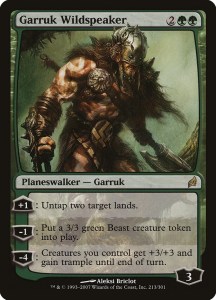
I didn’t fall for the planeswalker card type, but I did fall in love with the huge, manly, savage guy who happened to be a planeswalker.
I’ve always had a great affection for the beefcake and barbarian archetypes. I remember reading old issues of Conan when I was a little kid, and marveling at his wild might and musculature. This was mimicked in many other works I viewed at that age, like The Incredible Hulk, Dragonball Z, and Hokuto no Ken. Perhaps it was because I’d been the scrawny kid who everyone saw as weak, and I was looking up to these powerful men who could defeat any enemy with utter brutality. That affection evolved into a general attraction as I entered puberty, so I began to seek those sorts of characters out more and more. It is an ideal that I never had any desire to embody myself, but to instead admire it in others who possess it.
When I began exploring Garruk’s lore, I began to be captivated by his “hunter druid” nature. I’d been reading the MtG novels for years already, so I was very captivated by Magic’s worldbuilding and flavor. But with Garruk, I had digital comic books to read, which really got me excited. The story of Garruk’s fight with Liliana, “The Hunter and the Veil,” left a pretty bad taste in my mouth, but I had hope that Wizards would do something interesting with him soon. It took a year, but they did continue his story with “The Veil’s Curse,” which had a cool fight between Jace and Garruk, with Garruk breaking through the blue mage’s spells with ease. It was shortly followed by “The Wild Son,” which gave me a greatly appreciated insight into Garruk’s simple origins. This was the first story I really liked, and emboldened my interest in his character.
After reading the comics featuring Garruk, and learning of his humble beginnings, I began to really dislike the direction they’d taken his character. Being cursed by the evil wench Liliana, Garruk was corrupted and made ugly and vile. I really grew to hate Liliana as a character, and hoped that Wizards would find a way to cure and redeem Garruk. My greatest hope for this was a novel that was to be released back in 2010, called “The Curse of the Chain Veil”. However, it was never released, and I wouldn’t get anything lorewise concerning Garruk until 2012. Although, I did get several cool and interesting new Garruk cards while I waited, so my appetite was sated for a bit.
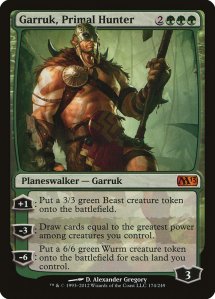
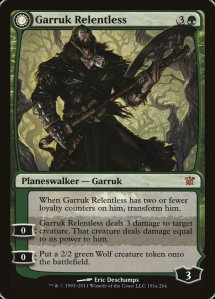
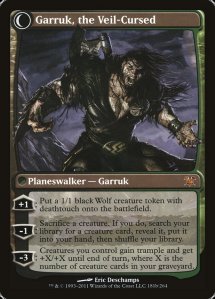
After Garruk’s story in Innistrad, where he was almost healed by Avacyn, his story became more and more dark, as he began to accept the curse, and the fate it brought him. I lamented this, especially with the culmination of this corruption storyline in M15, the Garruk-themed set. A part of me celebrated Garruk being center stage, but a larger part wished for the neutral-aligned mono-green hunter druid that I’d fallen for years ago. I’d felt that Wizards had run out of ideas for Garruk, and that they weren’t going to cleanse him of the curse that had turned him into a murderous, evil planeswalker hunter. But I have to admit, the card this version of Garruk received was pretty cool, and fun to play with.

As Wizards increased its efforts to gain new players in the coming years, I noticed that Garruk became nearly non-existent within the game. He’d seemed to have been completely replaced by the Elf planeswalker, Nissa Revane, who I saw as boring and unoriginal. The idea of a main character “hunter druid” had been somewhat fresh, but an elitist elf who was in touch with nature was a bromidic trope. I began to wonder why he’d been given a character-centric set, only to be abandoned at the climax of his corruption arc. I began to talk to others about this, and they told me to look at a card found in Innistrad called “Triumph of Ferocity”. I’d been out of the game during the Innistrad block, only peeking my head in to do a few drafts, so I wasn’t familiar with the cards, or the controversies, until I returned for the RtR block.
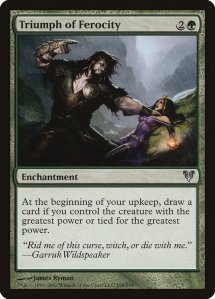
The Magic fanbase has been composed of a large number of immature, socially-inept guys as far back as I can remember (myself included, once upon a time), mainly consisting of young white males whose humor was oftentimes crass and disparaging. I’d oftentimes find myself at the butt of racist jokes, being the only black guy in some of the card shops I’d frequent. It didn’t bother me, because I knew that the guys were just being silly, and didn’t have hateful intentions. Nothing was off-bounds, whether it be sexist, homophobic, or racist. It was the sort of environment where you gained a tough-skin pretty quickly, because everyone else would point fun at your hurt feelings if you were offended by anything that was said. It was challenging, but also fun. It was an environment where you knew you could say pretty much anything you wanted. But that environment also incentivized saying the worst things you could think of, because it was a sure way to get a laugh.
That’s why I could understand how most of the guys I knew got a real kick out of the art displayed on Triumph of Ferocity. When I brought up the card to some MtG friends of mine, they always joked about it. Most of the jokes were sexual, saying things like, “Liliana and Garruk are so into each other, they even get into BDSM”.
It wasn’t much of a problem for magic players back then, but things quickly began to change as new, more diverse players began to flood into the game. Wizards was on a mission to make the game inclusive, and that meant removing things that would be “problematic” to new players who didn’t share the crass humor of many of the older players. A wave of inclusivity began to sweep through all sorts of industries and fandoms during 2015, as movements like Gamergate began to show a darker side of nerd culture to society at large. Wizards, being a center of nerd culture, made it a priority to clean up the public’s image of its nerdy player-base. “Triumph of Ferocity” began to be looked at by new players, and some of them began speaking about the sexism present in MtG. It is around this time that Garruk ceased to be present in the game. The writers of Wizards would add a little blurb about what he was up to every now and then, but that was it. I felt as though M15 had acted as a grand send-off to a character that Wizards realized needed to “disappear” for the good of the game’s inclusive future.
To me, it is tragic that Wizards would get rid of a character simply because of a single unflattering card art he was in years ago. It isn’t as though he was harming an innocent woman. Liliana and Garruk were engaged in a fight, where she had the upper hand. She refused to remove a curse that was partly responsible for Garruk’s aggression towards her. Liliana is an evil necromancer, obsessed with power and enamored with cruelty. She also got her turn to hurt Garruk during the fight, as depicted in “Triumph of Ferocity’s” opposing card, “Triumph of Cruelty”.
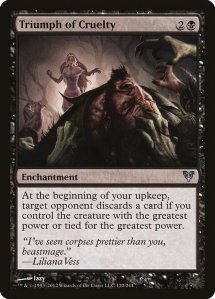
As The War of the Spark draws near, Magic’s first Planeswalker-themed set, I couldn’t help but reminisce about Garruk’s fate. 36 planeswalkers that will appear within the set have been revealed, with indications that they will be the only planeswalkers that will receive new cards within the set. Garruk was not among them, and hasn’t even been mentioned yet. Is this a confirmation that Wizards has indeed written him out of their larger narrative, relegating him to a few sentences in a “Catching Up” story now and then? I certainly hope not. And if there’s anything that Garruk has always given me, it’s hope that his character will get the compelling story he deserves.

 Disciple of the Vault