Magic the Gathering is a Rules System

There are so many people complaining about Universes Beyond. There are so many people saying that it’s the “end of Magic” or some such nonsense. How many of these people have ever read a Magic novel? How many of them have even read one of the online stories that WotC posts each set?

I think that the core issue with the complaints about Wizards of the Coast prioritizing UB sets is that they miss something vital about the game; Magic the Gathering‘s strength is in its gameplay, not in its creative intellectual property.

WotC used to knock it out of the park with three unique planes each year, during their Block era. They’d have three sets each block that allowed them to tell a fully-fleshed out three-act story with plot progression and character development. “Fatpacks,” as bundles used to be called, included the novels for each of those sets, creating full narratives based in these rich, fantasy worlds. You’d usually see at least one person in your local game store reading one of them during FNM.

If you’d ask the average Magic player even back then what was going on in the block’s story, they’d probably say that they didn’t know. What they did know about were the mechanics of the set and of the block, and how those mechanics affected the formats that they played. What the majority of players have always focused on was the gameplay, not the story, even when the story was good.

Magic the Gathering is a rules system that allows for the most complex gameplay that we’ve ever seen in a largely-played card game. Over the course of 31 years, over 25,000 unique cards (or game pieces, as WotC is known to call them) have been introduced to the game, as well as over 700 unique rules. Despite this incredible level of complexity, MtG continues to be a widely-played game that is picked up by thousands of new players each month. In fact, the game’s complexity is often cited as what attracts new players to the game.

Unlike its competitors, such as Yu-Gi-Oh! and Pokemon, Magic the Gathering has never had large success in adapting its creative IP across many forms of media. Despite its comic books, video games, and decades of novels, MtG’s characters and stories have failed to gain wider cultural appeal. WotC has tried for over 30 years to have their creative elements become apart of the mainstream, but no matter what they try, it has always seemed like a struggle with minimal benefits. WotC’s worldbuilding has won the praise of creative critics but it has merely existed as a vehicle for MtG’s gameplay. It is not MtG’s head creative who represents the game’s department but its head designer, Mark Rosewater, a person in charge of gameplay.

The introduction of playable, externally licensed creative intellectual property into Magic the Gathering came as a alt-art, subtitled Godzilla-themed cards in the Ikoria set back in 2020. These cards had mixed reviews when they were spoiled, but were quickly accepted and even celebrated by the larger player base. However, there were many players who saw such licensing as dangerous to the “purity” of the game and its own IP. These concerns were seemingly validated within the same year with the release of the mechanically-unique The Walking Dead cards. Players were very vocal about their distaste of having such cards in the game, especially since they were only available through the new limited-time, direct-to-consumer Secret Lair product line.

Despite WotC eventually creating “in-universe” versions of The Walking Dead cards, player trust had already been eroded. The next year brought Dungeons and Dragons sets, which were well-regarded gameplay-wise. Since the IP was within WotC’s portfolio, it was seen as more of a “sister-property” to that of MtG, but there were still Magic purists who were quite vocal about their dislike of an entire Standard-legal set being dedicated to a non-MtG IP. More mechanically-unique cards would come out in the following years, adding fuel to the fire. But despite all the criticism, these sets and Secret Lair bundles led to record-sales time and time again for WotC, and therefore Hasbro, their corporate owners. The incentive for WotC to delve more into what they called “Universes Beyond” became greater until it all came to a head with their best-selling set ever at the time, The Lord of the Rings: Tales of Middle-earth.

When WotC tells players that their concerns and criticisms of the increasing amount of UB sets is made less valid by how well those sets have sold, they are essentially telling the larger playerbase that “money talks”. This is a corporate way of saying “only a small vocal minority of you don’t like what we are doing”. If WotC, and therefore Hasbro, are to be believed, then most players are not only on board with the pivot to UB, but are quite happy about it. In fact, it only took a few more years for another UB set, Final Fantasy, to outperform The Lord of the Rings set. Is it possible that WotC knows their game better than its playerbase? Is it possible that they already told their playerbase over a decade ago that this would likely happen? I’d answer yes to both questions.

Mark Rosewater has written many articles about Magic and how it all works. Many of these articles, labeled “Making Magic” on the MtG official website, tell readers that Magic’s creator, Dr. Richard Garfield, always intended for MtG to be “bigger than the box it came in”. In fact, Mark regularly writes articles echoing these words to explain that Magic isn’t even just a game, but a hobby and a lifestyle. Mark, and by extension WotC, has always had big plans for Magic the Gathering. They knew that the strength of their game was in the system that they’d created, a system that is greater than its individual parts. What the MtG rules system allows for is a mechanism to turn nearly any interaction into an interesting, complex gameplay experience full of fun and creativity, regardless of the IP involved.
EDH Favourites : Mono-Colored

EDH/Commander is my favorite format. It allows such a wide range of deck-building options, and you can really express yourself through your decks. This appeals to me greatly, especially when I see theme decks, and especially flavorful decks. I tend to make either really powerful decks, or really casual decks.

I’d like to share my favorite commanders with all of you, within 4 different posts. This time, I will cover my favorite mono-color commanders. Mono-color commanders offer the purest color pie experience in EDH. The decks are oftentimes single-minded, having access to only one color. You really get to see the weaknesses and strengths of each color, even with access to nearly all of the cards in magic’s history.

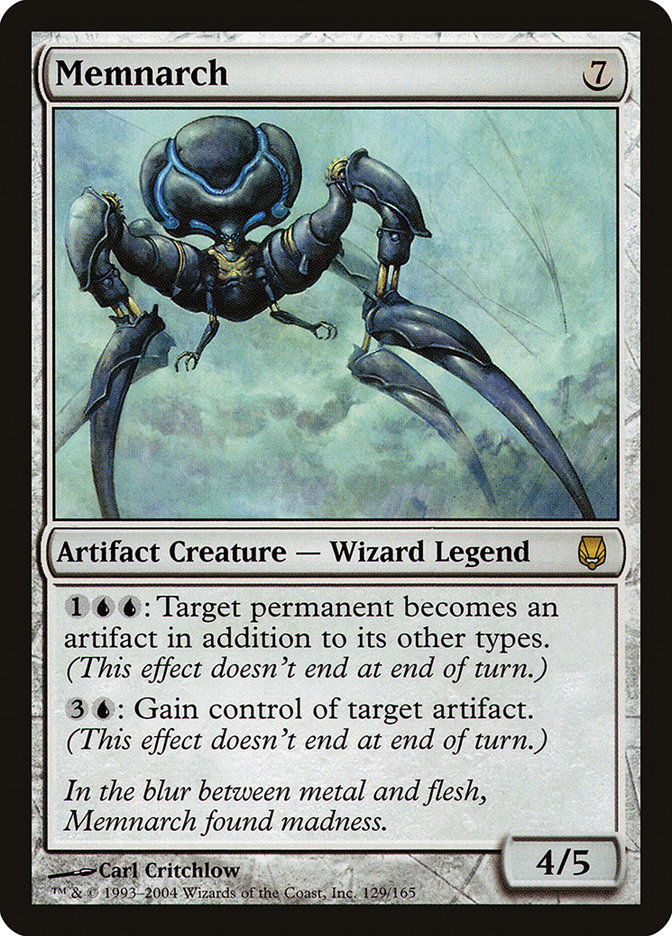
Mono-Blue : Memnarch

dst-129-memnarch.jpg

Memnarch is probably my favorite creature in MtG. He is the World Warden, the Wicked Wizard, the Obsessive Overlord. Memnarch takes your permanents…all of them.

With infinite mana, Memnarch serves as the best theft-based mana sink in the game. He keeps your opponents’ permanents….permanently. He turns card advantage on it’s head, by allowing you to gain an advantage while disadvantaging your opponents. Normally, filling your deck with mana producers seems underwhelming, but Memnarch turns any excess mana into additional permanents on your battlefield. He is oppressive, yes, which is why I only play him when I’m playing against other powerful combo decks. And with a head that big, how couldn’t he out-think his opponents?

Strength : Card Advantage

Weakness : Aggro Decks


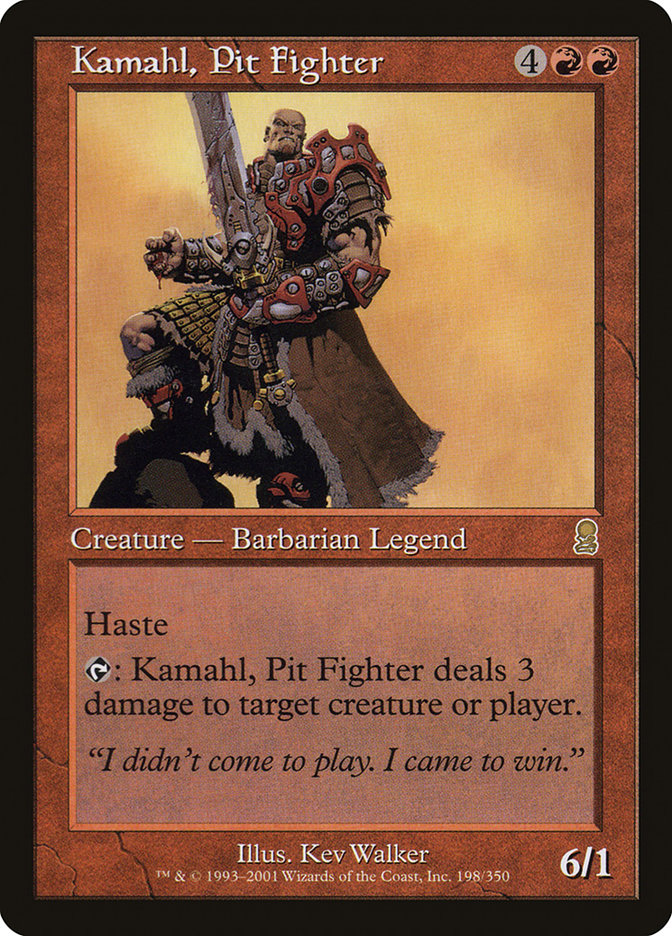
Mono-Red : Kamahl, Pit Fighter

ody-198-kamahl-pit-fighter.jpg

Kamahl is the champion of the Pit. He is a vicious gladiator, coating his massive blade with the blood of his opponents. Pretty manly, eh? Alas, he lacks stamina; he is a one-minute man. But man, does’ he know how to smash during that minute!

Kamahl is the king of pingers. He is a lightning bolt on a stick, who deals 3 damage to any target the moment he comes out of the command zone. But more importantly, he comes out swinging, possibly doing 6 commander damage to an unfortunate opponent. He is aggressive, and also shoots lightning bolts. To me, Kamahl is a red purist, epitomizing the classical aspects of the color. You can build him as tribal pingers, or you can voltron him up, or you could just run burn spells and hasty creatures. His versatility is his strength, just as it was in the Pit.

Strength : Damage

Weakness : Big Booty Blockers


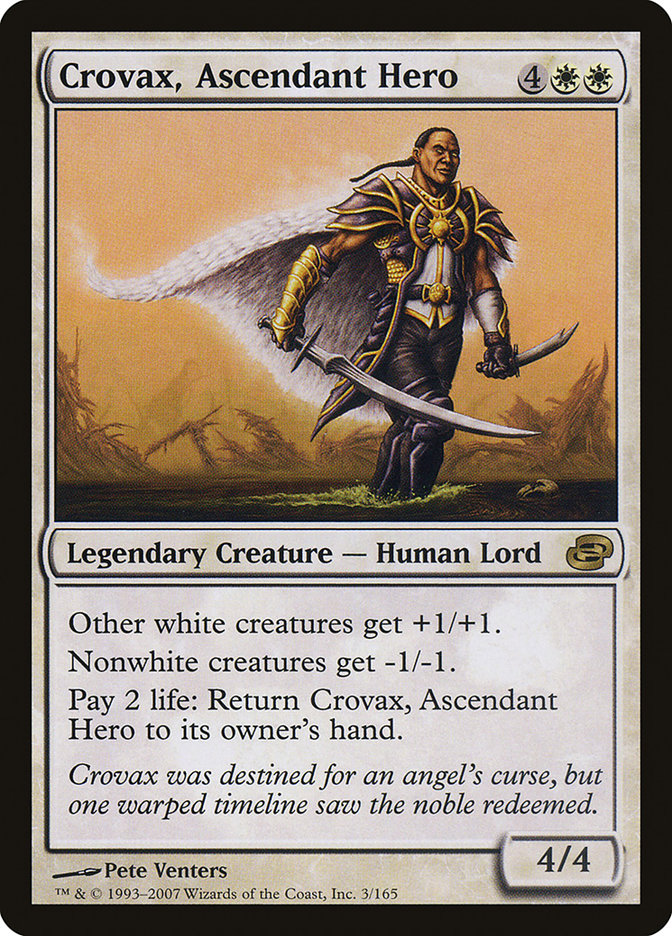
Mono-White : Crovax, Ascendant Hero

plc-3-crovax-ascendant-hero.jpg

The Time Spiral Block gave us so many amazing remixes of the color pie, game mechanics, and even previous characters. Crovax is known as being a merciless vampire, corrupted by Phyrexia and turned against his previous allies. His story is complex and nuanced, creating a multi-faceted character with a living, breathing history. In typical What-If fashion, Planar Chaos gave us a parallel universe-version of Crovax, who’d been cleansed of his corruption, and who became an incredible force for good.

I love Crovax, and always wished he’d gotten a happier ending during the Weatherlight Saga. This card gave him that happier ending. Because he fights against the evil that had corrupted him, and as such, I build him with a Black-Hate theme. Because he fights the darkness, I have him joined by a team of creatures that have Protection from Black, and various tools to lock down their black minions and the swamps they come from. Crovax is an anthem that can be saved from nearly everything for 2 life, who sometimes nerfs your opponents’ creatures. He is the hero we deserve, but not the one we need when we’re not going against a black deck. 😀

Strength: Going against Mono-Black decks

Weakness : Going against another Mono-White deck


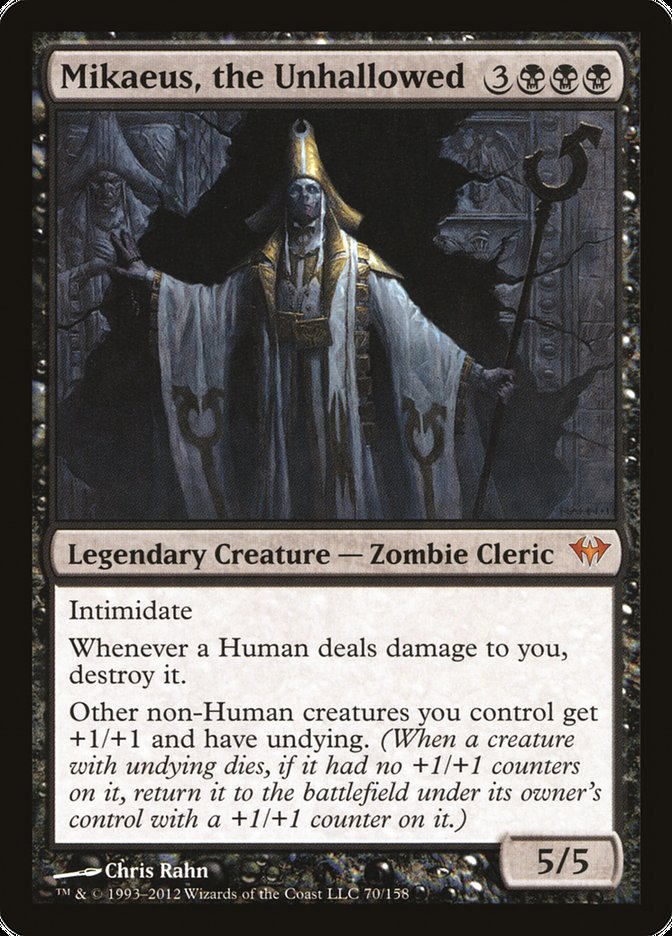
Mono-Black : Mikaeus, the Unhallowed

dka-70-mikaeus-the-unhallowed.jpg

Poor Mikaeus. Once a religious leader, he was turned into a zombie by that evil wench, Liliana. Just as she corrupted my favorite Planeswalker, Liliana defiled the pious Mikaeus, and used him as a puppet for her own ends. A tragic end to a holy man who tried his hardest to preserve a dying faith.

This Zombie is actually a combo machine. He goes infinite with so many cards that it borders on ridiculous. And with access to Black, you can easily tutor for all of your combo pieces. Bring pack your creatures endlessly, while draining or pinging your opponents to death death in the process. It’s easy as 1. 2. 3 combo pieces! I solemnly swear as a Johnny player that Mikaeus is a combo player’s wet dream. Humorously enough, I almost always forget that he destroys humans that deal damage to you!

Strength: Winning Outright

Weakness: Getting Hated Off the Table


Mono-Green : Kamahl, Fist of Krosa

ons-268-kamahl-fist-of-krosa.jpg

Look who decided to become a member of the Green Party! Kamahl had a revelation within the deepest parts of the Forest of Krosa, and spent a great deal of time meditating on all of his past crimes as a Mono-Red brute. Being taught by the forest and it’s protectors, Kamahl became a druid, and found an inner peace through continued meditation. His future was not a peaceful one, however, seeing how he was forced to kill his own sister, who’d essentially been turned into an avatar of death by the evil Cabal.

Kamahl’s Green incarnation is even more versatile than his red one. Not only does he turn lands into prime targets for removal, but he also pumps your entire team. Overrunning your opponents with infinitely big creatures is always good for a laugh, and a win! Just as he epitomized the classic features of Red in his previous card, the Kamahl represents what makes Green great; the ability to punch your opponents really hard. I mean, look at those bulging muscles!

Strength: Big Brawny Creatures

Weakness: Board Wipes


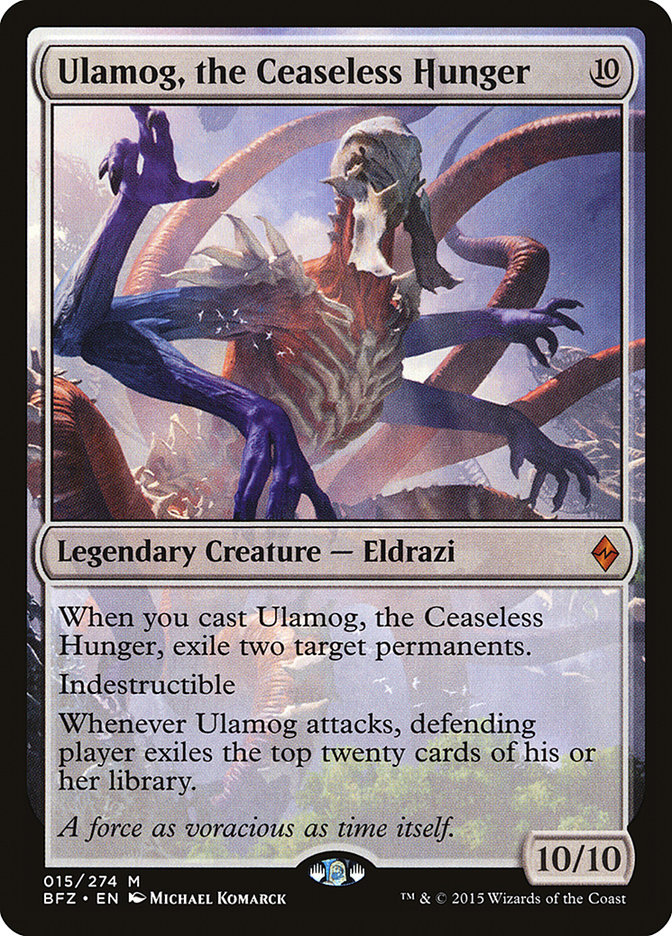
*Colorless – Ulamog, the Ceaseless Hunger

bfz-15-ulamog-the-ceaseless-hunger.jpg

To finish things off, let’s cover the mysterious and inherently weak Colorless….color? Not having access to colored mana drastically reduces your options for things like early interaction, but it doesn’t matter when you fill your deck with artifact ramp and slam down the always cranky, never lackluster Ulamog.

Eldrazi Titans are notorious for their cast triggers, which normally ensure that you aren’t wasting large amounts of mana to cast a spell that might just end up getting countered. Spending 10 mana to exile two permanents is pretty amazing by itself, but imagine getting a 10/10 indestructible creature out of that has a disgusting attack trigger! And by the way, you always have access to it! EDH is one helluva format, eh?

Strength: Exiling Stuff

Weakness: Slow to Interact


Tune in next time for my favorite 2-color commanders!