
There are so many people complaining about Universes Beyond. There are so many people saying that it’s the “end of Magic” or some such nonsense. How many of these people have ever read a Magic novel? How many of them have even read one of the online stories that WotC posts each set?
I think that the core issue with the complaints about Wizards of the Coast prioritizing UB sets is that they miss something vital about the game; Magic the Gathering‘s strength is in its gameplay, not in its creative intellectual property.
WotC used to knock it out of the park with three unique planes each year, during their Block era. They’d have three sets each block that allowed them to tell a fully-fleshed out three-act story with plot progression and character development. “Fatpacks,” as bundles used to be called, included the novels for each of those sets, creating full narratives based in these rich, fantasy worlds. You’d usually see at least one person in your local game store reading one of them during FNM.
If you’d ask the average Magic player even back then what was going on in the block’s story, they’d probably say that they didn’t know. What they did know about were the mechanics of the set and of the block, and how those mechanics affected the formats that they played. What the majority of players have always focused on was the gameplay, not the story, even when the story was good.
Magic the Gathering is a rules system that allows for the most complex gameplay that we’ve ever seen in a largely-played card game. Over the course of 31 years, over 25,000 unique cards (or game pieces, as WotC is known to call them) have been introduced to the game, as well as over 700 unique rules. Despite this incredible level of complexity, MtG continues to be a widely-played game that is picked up by thousands of new players each month. In fact, the game’s complexity is often cited as what attracts new players to the game.
Unlike its competitors, such as Yu-Gi-Oh! and Pokemon, Magic the Gathering has never had large success in adapting its creative IP across many forms of media. Despite its comic books, video games, and decades of novels, MtG’s characters and stories have failed to gain wider cultural appeal. WotC has tried for over 30 years to have their creative elements become apart of the mainstream, but no matter what they try, it has always seemed like a struggle with minimal benefits. WotC’s worldbuilding has won the praise of creative critics but it has merely existed as a vehicle for MtG’s gameplay. It is not MtG’s head creative who represents the game’s department but its head designer, Mark Rosewater, a person in charge of gameplay.
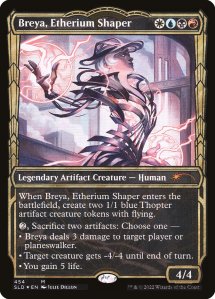
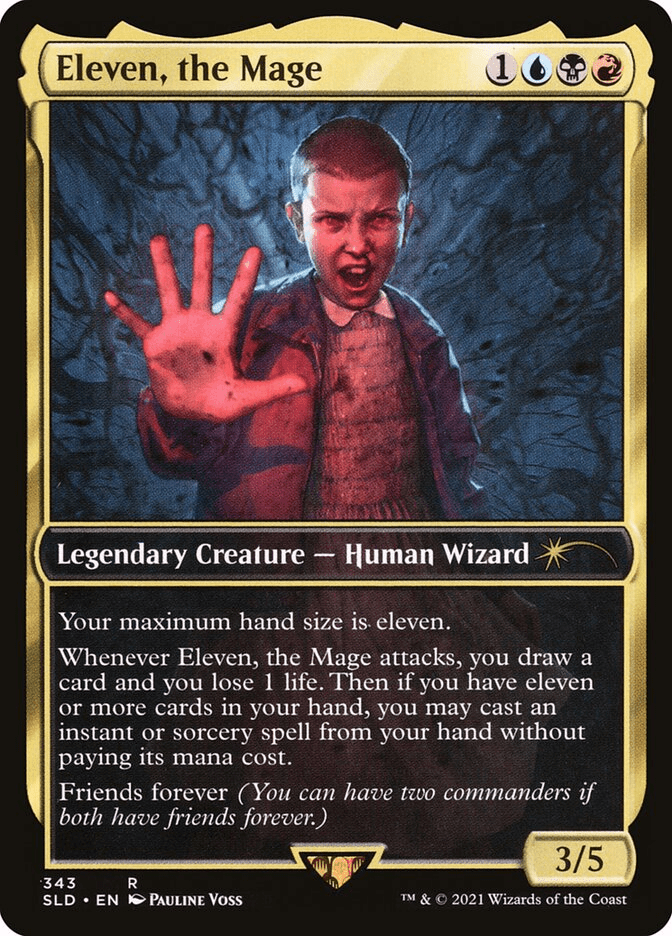
The introduction of playable, externally licensed creative intellectual property into Magic the Gathering came as a alt-art, subtitled Godzilla-themed cards in the Ikoria set back in 2020. These cards had mixed reviews when they were spoiled, but were quickly accepted and even celebrated by the larger player base. However, there were many players who saw such licensing as dangerous to the “purity” of the game and its own IP. These concerns were seemingly validated within the same year with the release of the mechanically-unique The Walking Dead cards. Players were very vocal about their distaste of having such cards in the game, especially since they were only available through the new limited-time, direct-to-consumer Secret Lair product line.
Despite WotC eventually creating “in-universe” versions of The Walking Dead cards, player trust had already been eroded. The next year brought Dungeons and Dragons sets, which were well-regarded gameplay-wise. Since the IP was within WotC’s portfolio, it was seen as more of a “sister-property” to that of MtG, but there were still Magic purists who were quite vocal about their dislike of an entire Standard-legal set being dedicated to a non-MtG IP. More mechanically-unique cards would come out in the following years, adding fuel to the fire. But despite all the criticism, these sets and Secret Lair bundles led to record-sales time and time again for WotC, and therefore Hasbro, their corporate owners. The incentive for WotC to delve more into what they called “Universes Beyond” became greater until it all came to a head with their best-selling set ever at the time, The Lord of the Rings: Tales of Middle-earth.
When WotC tells players that their concerns and criticisms of the increasing amount of UB sets is made less valid by how well those sets have sold, they are essentially telling the larger playerbase that “money talks”. This is a corporate way of saying “only a small vocal minority of you don’t like what we are doing”. If WotC, and therefore Hasbro, are to be believed, then most players are not only on board with the pivot to UB, but are quite happy about it. In fact, it only took a few more years for another UB set, Final Fantasy, to outperform The Lord of the Rings set. Is it possible that WotC knows their game better than its playerbase? Is it possible that they already told their playerbase over a decade ago that this would likely happen? I’d answer yes to both questions.
Mark Rosewater has written many articles about Magic and how it all works. Many of these articles, labeled “Making Magic” on the MtG official website, tell readers that Magic’s creator, Dr. Richard Garfield, always intended for MtG to be “bigger than the box it came in”. In fact, Mark regularly writes articles echoing these words to explain that Magic isn’t even just a game, but a hobby and a lifestyle. Mark, and by extension WotC, has always had big plans for Magic the Gathering. They knew that the strength of their game was in the system that they’d created, a system that is greater than its individual parts. What the MtG rules system allows for is a mechanism to turn nearly any interaction into an interesting, complex gameplay experience full of fun and creativity, regardless of the IP involved.


 Disciple of the Vault