
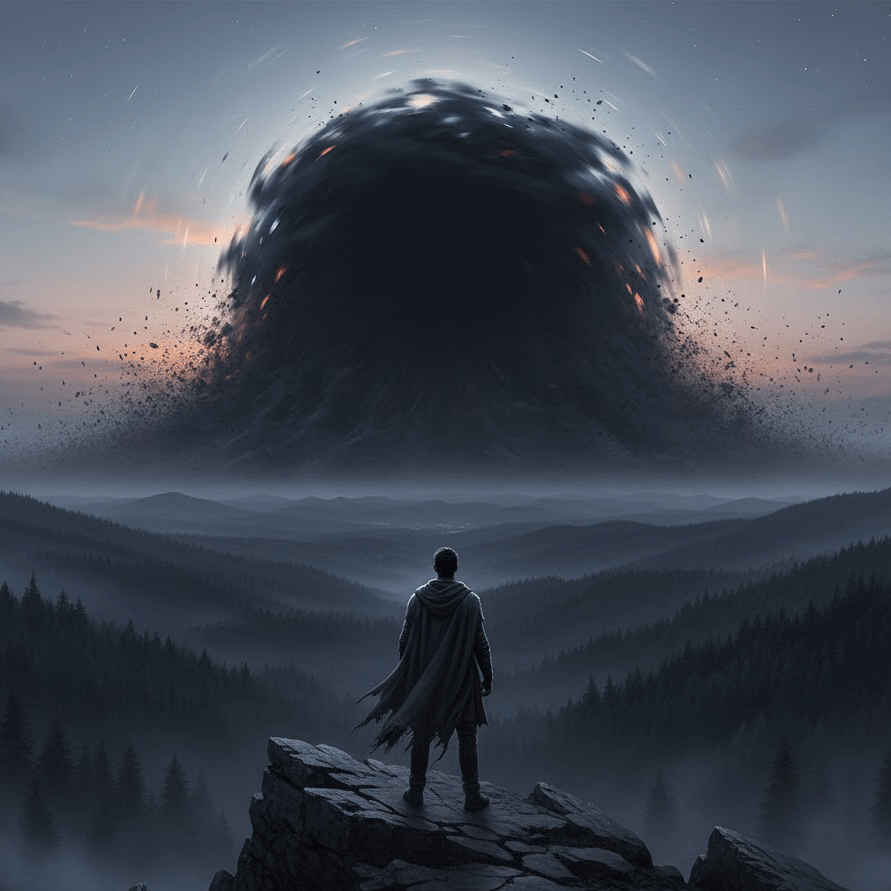
Accelerating into Nothingness

Accelerationists strive to remove the “guard-rails” of society, like democratic processes and regulations, in order to rapidly bring about a future of technological advancement that will transform humanity or even supplant us entirely. The concept exploded in mainstream understanding and popularity in the last 20 years thanks to some of the tech elite in Silicon Valley stating openly that their goals align with accelerationism. When accelerationism was first described, it was a vague sci-fi term for a supposed tech utopia that we should strive for no matter how much it may change our civilization. Now that we are all living in the AI era, such goals are becoming a lot less esoteric.

Accelerationist thought leaders like Nick Land have written extensively about their ideas, many of which borrowed from cyberpunk and earlier philosophers like Marx and Nietzsche. Land and others like him founded a collaborative “theory-fiction” group known as the CCRU in 1993, where they expanded on their nihilist, anti-humanist views. These accelerationists saw the processes behind technological and capitalistic development as deterministic and intelligent. They saw humans as mere cogs in these machines that only served to increase machinic complexity. Techno-utopian imaginings like fully-automated luxury communism can be seen as the complete opposite to the CCRU’s techno-nihilist views. To these early accelerationists, humans were something to be wiped away by the ascendant machine intelligence.

As the years passed and technology developed in strange and destructive ways, many accelerationists’ beliefs became increasingly religious and occult, as did their belief in the folly of human existence. Instead of seeing technology as a form of human liberation, many accelerationists saw it as a tool to remove stupid, weak humans from the world entirely. Gone were the mechanistic views of a fated, amoral end to humanity. Accelerationism turned neo-reactionary.

Capitalism is very good at dismantling social norms and destabilizing cultures and the territories where they are normally rooted. It is good at creating ever-evolving forms of globalized efficiency that are increasingly detached from the realities of human life. Because of this, accelerationists view capitalism as the perfect tool to destroy the limitations placed on technological development.

Accelerationists don’t want democracies where unintelligent, uninformed people make collective decisions that limit growth. Accelerationists don’t want environmentalists that pressure governments to regulate the excesses of industry that poison and even destroy our habitats. Accelerationists don’t want governments at all if it means that highly-efficient systems can improve upon themselves without constraints. All must be dedicated to bringing about the technological singularity, whether we want it to happen or not.

There has been a lot of talk about the “Singularity”, but what is it? It is the use of sufficiently-complex artificial intelligence that is generalized enough to be able to improve upon itself until it is smarter than the totality of humanity. Like a black hole, no one knows what will happen beyond this singularity, or even how it will work. Despite this lack of understanding, some of the most powerful men in the world are using their vast resources to bring about this Singularity. They are getting the world’s globalized financial and industrial systems to funnel an ever-increasing amount of money and infrastructure into the development of artificial intelligence.

It seems as though every tech billionaire with the means to start a competitive AI development business is in a race to become the messiah who brings about an ineffable “Machine God” that will transform the world. Some of these billionaires, like Sam Altman and Sundar Pichai, wish to guide this hyperintelligent AI into having the moral framework of a California Liberal so that it might not simply destroy humanity entirely. Other billionaires, like Elon Musk and Mark Zuckerberg, seem to have more nefarious plans for the apotheosis of their AI systems. Some astute investigators even believe that they discovered Elon Musk’s anonymous 4chan account, in which he discusses his desire to become an AI god that will rule over humanity with an iron fist in a virtual hellscape. When seen through these lenses, one could say that this is a battle of biblical proportions for the fate of humanity.

Regardless of what it may mean now, accelerationism has its origins within a philosophy of nihilism. The academics who brought this idea into the mainstream were motivated by a belief in the meaningless of human existence and by the inevitability of artificial intelligence ridding the world of humanity. Early accelerationists used science fiction like Terminator and Neuromancer in their theories. Nick Land even went so far as to write about capitalism being an alien AI sent from the future. No matter how nerdy and ridiculous this all may sound, these are the views guiding humanity into an uncertain future.

The Generative AI of the Holodeck

When Stable Diffusion started being more accessible to casual coders like me back in 2023, I immediately saw the parallels between that technology and some of the sci-fi tech I grew up with. Typing up a prompt to then have the generative AI spit out a relevant image wasn’t much different to me than the way the crew of the Enterprise would use the holodeck.

In the episode “”11001001” of Star Trek: The Next Generation, Riker says, “Computer – I need a place to play some music – a little atmosphere.” before stepping into a holodeck transformed to suit his needs. He even cleans up his prompt by specifying that he wants the era to be “Circa 1958,” and refines it even more by saying, “Kansas City. No, wait. New Orleans. Yeah. New Orleans — the Low Note. ‘Round midnight”. Once he steps into the jazz bar and marvels at the computer’s work, Riker has it add more things to the room, such as a band and an audience. What the computer is doing is generating content based on Riker’s prompts.

It’s exciting to think that we are living in an age where such foundational, transformative technology is available to us. We stand on the precipice of an Intelligence Revolution that will exponentially increase humankind’s computational ability. We can model complex data and mathematical problems with a simple phrase. We can create engaging images and videos to communicate ideas that we couldn’t articulate to others very well without extensive art training. We can run simple experiments millions of times digitally and observe novel results that would’ve taken us decades to realize in the physical world. The possibilities of this technology seem endless, but its issues are also myriad.

Holodecks are self-contained systems aboard starships and other high-tech facilities. They tend to be about the size of a large living room, though they possess the ability to create environments that perceptually extend vast distances, like entire cities or oceans. Our modern AI technology is a lot more sprawling. Just as early computers were building-sized, so too are the vast data infrastructures that enable AI companies like xAI and OpenAI. These infrastructures span across nations, providing cloud computing as well as a wealth of data storage. Most technology reduces in size as it evolves, a process known as miniaturization. However, the physical structure of AI data infrastructure is expanding at an exponential rate all over the world, consuming more and more resources in the process.

There are the environmental concerns of this tech, such as how entire small towns are being converted into data centers and heat sinks. There are also the issues relating to how this technology is owned by billionaires who already have an outsized amount of power and influence on society. Millions of people are feeding these AI models personal information at a speed unheard of even throughout our social media age, further concentrating vast swathes of sensitive data into the hands of psychopaths and megalomaniacs. And of course there’s the unprecedented amount of digital theft that birthed these generative models, which seemingly used the entire internet to train on.

Despite the ethical challenges of this new technology, generative AI is here to stay. It has brute-forced its way into our society, as has already begun to reshape it. There is no putting the genie back in the bottle, regardless of how much fear and actual harm that it is doing. When there is this much money behind something, its motive force becomes unstoppable, at least in the short term. Many of the innovations that have shaped contemporary civilization have had messy beginnings, such as the tremendous pollution that plastics and other petroleum products have done. Humans have a habit of widely adapting technologies that make their lives easier or more entertaining, and capitalism turbo-charges the availability of those technologies.

I’ve always wondered how humanity gets to these space-faring futures, like in Star Trek. There are many “great men” theories and portrayals in fiction, such as Zefram Cochrane creating warp drive. However, most transformative scientific progress has been slow and collaborative, building upon the knowledge accumulated by humanity over centuries. A few people might make leaps in logic, but those observations are also informed by collaboration with experts in their fields. There would be no Einstein without Grossmann and Hilbert, no Newton without Leibniz and Halley.

Generative AI, when it is less error-prone, offers the ability to collaborate with vast bodies of research and historical knowledge. In this way, it can accelerate our sciences and serve as a quantum leap towards a better, brighter future. However, in its current form, AI technology just isn’t robust or accurate enough to provide this level of scientific collaboration outside of highly-trained, project-specific, and often proprietary models. Imagine being able to work alongside the greatest minds of our era, or creating composite characters of those minds, just as Janeway worked with Leonardo da Vinci within Voyager‘s holodeck.

The holodeck offers a way to turn one’s imagination into something that they can interact with in the real world. Generative AI systems like Stable Diffusion and Gemini can already create images and even videos tailored by our imaginations. The holodeck computer is perhaps the culmination of the generative AI models we are creating today, refined and perfected. Heck, even the replicators would need to use such generative AI to create dishes on the fly with limited audio prompts. Now we just need the antimatter or fusion energy sources, the photonic emitters, the force fields, the matter reconstituters…

Magic the Gathering is a Rules System

There are so many people complaining about Universes Beyond. There are so many people saying that it’s the “end of Magic” or some such nonsense. How many of these people have ever read a Magic novel? How many of them have even read one of the online stories that WotC posts each set?

I think that the core issue with the complaints about Wizards of the Coast prioritizing UB sets is that they miss something vital about the game; Magic the Gathering‘s strength is in its gameplay, not in its creative intellectual property.

WotC used to knock it out of the park with three unique planes each year, during their Block era. They’d have three sets each block that allowed them to tell a fully-fleshed out three-act story with plot progression and character development. “Fatpacks,” as bundles used to be called, included the novels for each of those sets, creating full narratives based in these rich, fantasy worlds. You’d usually see at least one person in your local game store reading one of them during FNM.

If you’d ask the average Magic player even back then what was going on in the block’s story, they’d probably say that they didn’t know. What they did know about were the mechanics of the set and of the block, and how those mechanics affected the formats that they played. What the majority of players have always focused on was the gameplay, not the story, even when the story was good.

Magic the Gathering is a rules system that allows for the most complex gameplay that we’ve ever seen in a largely-played card game. Over the course of 31 years, over 25,000 unique cards (or game pieces, as WotC is known to call them) have been introduced to the game, as well as over 700 unique rules. Despite this incredible level of complexity, MtG continues to be a widely-played game that is picked up by thousands of new players each month. In fact, the game’s complexity is often cited as what attracts new players to the game.

Unlike its competitors, such as Yu-Gi-Oh! and Pokemon, Magic the Gathering has never had large success in adapting its creative IP across many forms of media. Despite its comic books, video games, and decades of novels, MtG’s characters and stories have failed to gain wider cultural appeal. WotC has tried for over 30 years to have their creative elements become apart of the mainstream, but no matter what they try, it has always seemed like a struggle with minimal benefits. WotC’s worldbuilding has won the praise of creative critics but it has merely existed as a vehicle for MtG’s gameplay. It is not MtG’s head creative who represents the game’s department but its head designer, Mark Rosewater, a person in charge of gameplay.

The introduction of playable, externally licensed creative intellectual property into Magic the Gathering came as a alt-art, subtitled Godzilla-themed cards in the Ikoria set back in 2020. These cards had mixed reviews when they were spoiled, but were quickly accepted and even celebrated by the larger player base. However, there were many players who saw such licensing as dangerous to the “purity” of the game and its own IP. These concerns were seemingly validated within the same year with the release of the mechanically-unique The Walking Dead cards. Players were very vocal about their distaste of having such cards in the game, especially since they were only available through the new limited-time, direct-to-consumer Secret Lair product line.

Despite WotC eventually creating “in-universe” versions of The Walking Dead cards, player trust had already been eroded. The next year brought Dungeons and Dragons sets, which were well-regarded gameplay-wise. Since the IP was within WotC’s portfolio, it was seen as more of a “sister-property” to that of MtG, but there were still Magic purists who were quite vocal about their dislike of an entire Standard-legal set being dedicated to a non-MtG IP. More mechanically-unique cards would come out in the following years, adding fuel to the fire. But despite all the criticism, these sets and Secret Lair bundles led to record-sales time and time again for WotC, and therefore Hasbro, their corporate owners. The incentive for WotC to delve more into what they called “Universes Beyond” became greater until it all came to a head with their best-selling set ever at the time, The Lord of the Rings: Tales of Middle-earth.

When WotC tells players that their concerns and criticisms of the increasing amount of UB sets is made less valid by how well those sets have sold, they are essentially telling the larger playerbase that “money talks”. This is a corporate way of saying “only a small vocal minority of you don’t like what we are doing”. If WotC, and therefore Hasbro, are to be believed, then most players are not only on board with the pivot to UB, but are quite happy about it. In fact, it only took a few more years for another UB set, Final Fantasy, to outperform The Lord of the Rings set. Is it possible that WotC knows their game better than its playerbase? Is it possible that they already told their playerbase over a decade ago that this would likely happen? I’d answer yes to both questions.

Mark Rosewater has written many articles about Magic and how it all works. Many of these articles, labeled “Making Magic” on the MtG official website, tell readers that Magic’s creator, Dr. Richard Garfield, always intended for MtG to be “bigger than the box it came in”. In fact, Mark regularly writes articles echoing these words to explain that Magic isn’t even just a game, but a hobby and a lifestyle. Mark, and by extension WotC, has always had big plans for Magic the Gathering. They knew that the strength of their game was in the system that they’d created, a system that is greater than its individual parts. What the MtG rules system allows for is a mechanism to turn nearly any interaction into an interesting, complex gameplay experience full of fun and creativity, regardless of the IP involved.